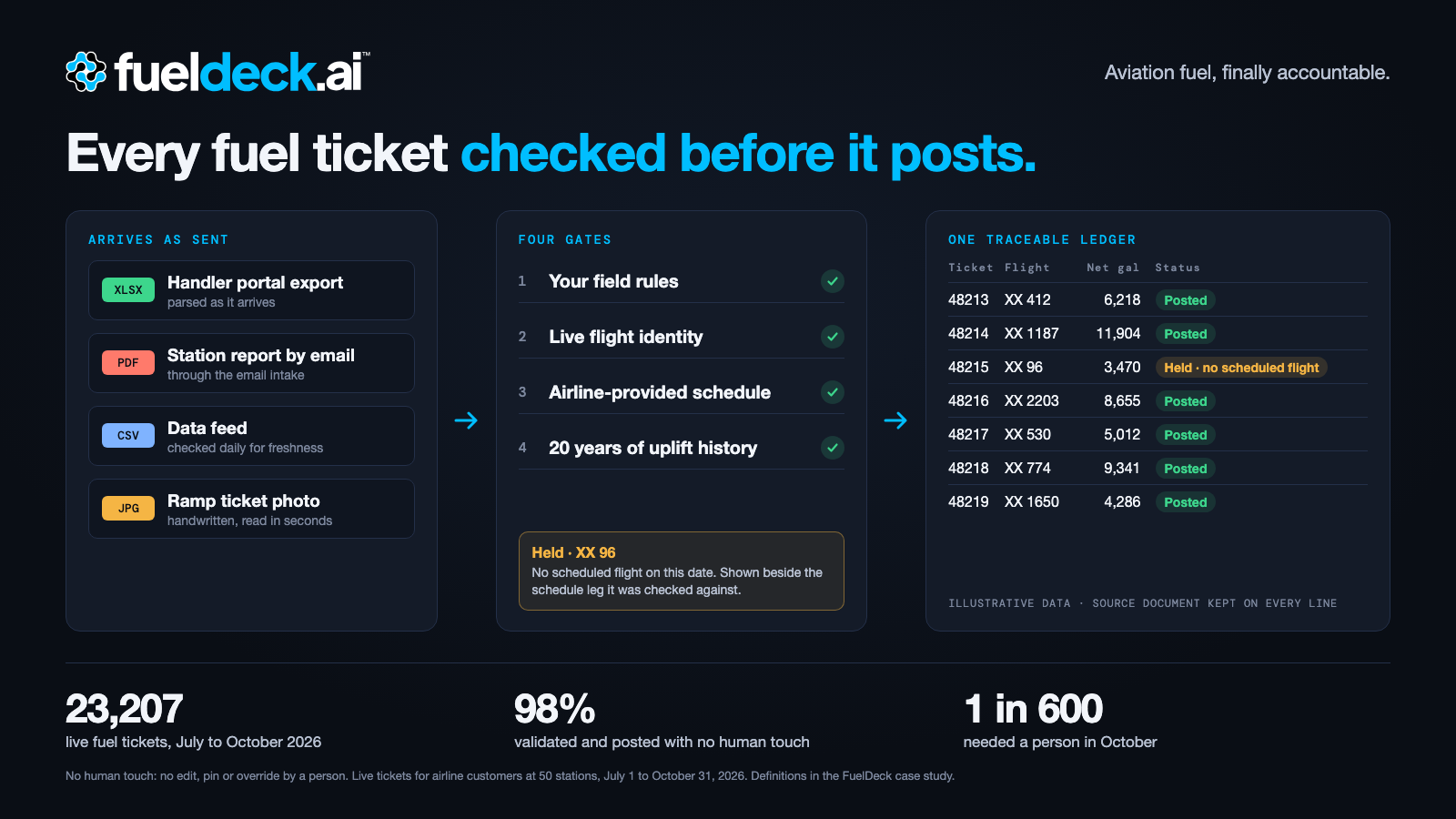
After 30 years of running fuel accounting for airlines and a four-month production run of 23,207 live fuel tickets at 98 percent with no human touch, the Englewood Cliffs firm ships an AI platform that reads any fuel record in whatever form it arrives, matches every uplift to the flight the airline actually scheduled, heals the ones that fail, learns from every correction, and hands finance a record it can post and defend.
ENGLEWOOD CLIFFS, N.J., November 3, 2026 — Logicraft Corporation, the aviation fuel accounting firm founded by Avery Kraft in 1994, today announced the launch of FuelDeck™ (fueldeck.ai), an AI-driven aviation fuel data platform that collects fuel records from every source, scans digital and handwritten fuel tickets, reads them the way a fuel accountant would, checks every quantity and flight detail, and delivers traceable data to the teams and systems that reconcile and account for fuel. The AI is trained on real fuel tickets rather than generic documents, heals tickets that fail their checks onto the flight that actually operated, and learns from every correction a reviewer makes, with a person at each gate. FuelDeck™ is built for fuel accounting teams at airlines, for into-plane fueling agents, and for airports and fuel consortia that still turn handler files, portal exports and ramp tickets into accounting by re-keying and spreadsheet reconciliation.
Every uplift of jet fuel produces a record, and it reaches the airline in whatever shape the handler's systems give it: an Excel or CSV export from an agent portal, a PDF report in an inbox, a thermal receipt, and for a significant share of uplifts a ticket written by hand at the wing. Between the wing tip and the ledger that record passes through fuelers, portals, email, spreadsheets and file drops in formats nobody standardised, and it is re-keyed, checked and reconciled by hand. A 2026 Skymetrix study of 1.12 million airline fuel and airport-charge invoices across 31 airlines found that 40 percent still arrive as paper or unstructured PDF and are keyed by hand, with a keying error in roughly one entry in 28, and put the undetected errors airlines pay out at $4.6 billion a year. Fuel is one of the largest costs an airline carries, and the record of every gallon starts as a ticket written at the aircraft.
Proven on live tickets before launch
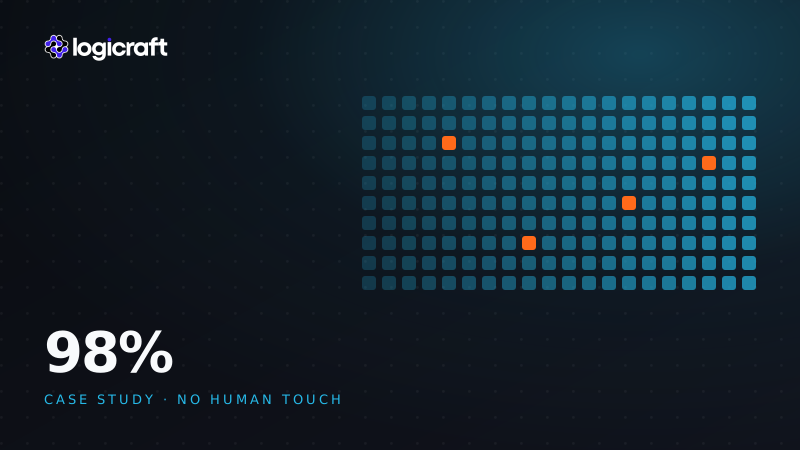
Logicraft did not launch FuelDeck™ on a demonstration. From July 1 through October 31, 2026 it ran the platform on live fuel tickets for its airline customers, about 190 a day for 395 aircraft at 50 stations, most of them in North America and the Caribbean, through the managed fuel-data service the firm has provided by hand since 1994. Every one of those tickets arrived as the Excel, PDF and CSV files handlers already produce, through agent portals, data feeds and the email intake; none was scanned at a desk. In the first month, 98.9 percent of tickets were validated and posted without a human touch, with an operator kept in the loop out of caution. On September 23 the operator stepped out: a nightly validation sweep and an hourly posting job took over, and a stricter gate that matches every ticket to the airline's schedule went live. Exceptions rose to 3.9 percent that month, then the platform healed them on its own and they fell to 0.2 percent in October. Four months and 23,207 tickets later, 98 percent were validated and posted with no human touch, and 348 tickets, 1.5 percent, needed a person's decision: a fuel day on an overnight flight, a tail number after an aircraft swap, a schedule mismatch to rule on. In October it was one ticket in 600. Only one decision changed a quantity, a meter reading misread by 1,000 gallons, and together those decisions took about eleven and a half hours of people's time across the whole run, about six minutes a day. Every figure is read from the production database, not sampled, and the definitions behind each one are published in the case study.
No human touch: the ticket was validated against the airline schedule and posted without anyone pinning a fuel day, flight or tail, editing a field, overriding a check or triggering a revalidation. A person clicking Post on a ticket the system already validated does not count as a touch. The condensed case study has the month-by-month charts.
“We spent three decades doing this work by hand for airlines, so we know exactly where the numbers go wrong and what an auditor asks for,” said Avery J. Kraft, Founder and Chief Executive Officer of Logicraft Corporation. “The cost in fuel accounting does not sit in the ticket. It sits in the hand-off. The agent writes the ticket once and has to deliver it, correctly and in a different shape, to every airline it serves. The airline has to turn tickets from every agent at every station into one ledger it can defend. In between sit the re-keying, the chargeback filed a month later, the second truck written off as a duplicate, and the ticket a source quietly revises after it has posted. Those are not exceptions. They are the ordinary texture of the work, and the industry has been absorbing their cost for decades.”
“FuelDeck™ is that experience turned into software. Every rule in it was written down and signed off by people who did this work by hand for thirty years. When it holds a ticket, it says why, beside the schedule leg it failed. When it posts one, the source document, the review decisions and the delivery status stay on the line. Whatever arrives goes in. An audited ledger comes out. Every gallon traces back to its source document and to the flight it was pumped into.”
Two sides of the same ticket
The fuel ticket is a hand-off. The into-plane agent produces it on the ramp and has to get it, correctly and in the right shape, to every airline it serves. The airline consumes tickets from every agent at every station and has to turn them into one ledger it can reconcile, defend and file. Airports and fuel consortia hold the fuel farm in between and have to make receipts, transfers and uplifts tie out. FuelDeck™ serves all three from one record. For the airline, every uplift is matched to a scheduled flight and screened against two decades of history before it posts. For the agent, the ticket is read in seconds, checked against the airline's schedule before it leaves, and delivered in the airline's own format. For the airport, receipts, transfers and uplifts sit on one ledger with the statement comparison built in.
“Aviation has digitised almost everything downstream of the fuel ticket and almost nothing upstream of it,” said Ronny Kraft, Chief Technology Officer, who led the FuelDeck™ build from first prototype through launch. “Fuel is one of the largest costs an airline carries, and for a significant share of uplifts the record that anchors the gallons is still a meter reading written by hand at the wing, often at night, with the aircraft waiting. The invoice, the inventory and the tax filing all inherit whatever that ticket says, whether it reached finance as a spreadsheet row, a PDF page or a photograph. Reading the ticket was never the hard problem. The hard problem is proving it: that this uplift went onto this flight, on this tail, in this quantity, before a finance team pays for it. FuelDeck™ was built to prove the ticket, not just to read it.”
“Most of what the industry calls AI for documents stops at extraction, and extraction is the easy end of the problem. The AI in FuelDeck™ is trained on into-plane fuel tickets, and its work begins where extraction ends. It knows when it is unsure and sends the ticket to a person rather than guess. When a ticket is held because the flight written on it never operated, it goes back to the airline's schedule and the live flight record and heals the ticket onto the flight that actually fuelled. Every correction a reviewer makes teaches it, so a mistake fixed in October does not come back in November. None of that runs without a person at the gate, and that is the design, not a limitation. The next decade of aviation finance will be decided by whether the record can be trusted at the source. That is where we chose to build.”
Reads the ticket as it actually arrives
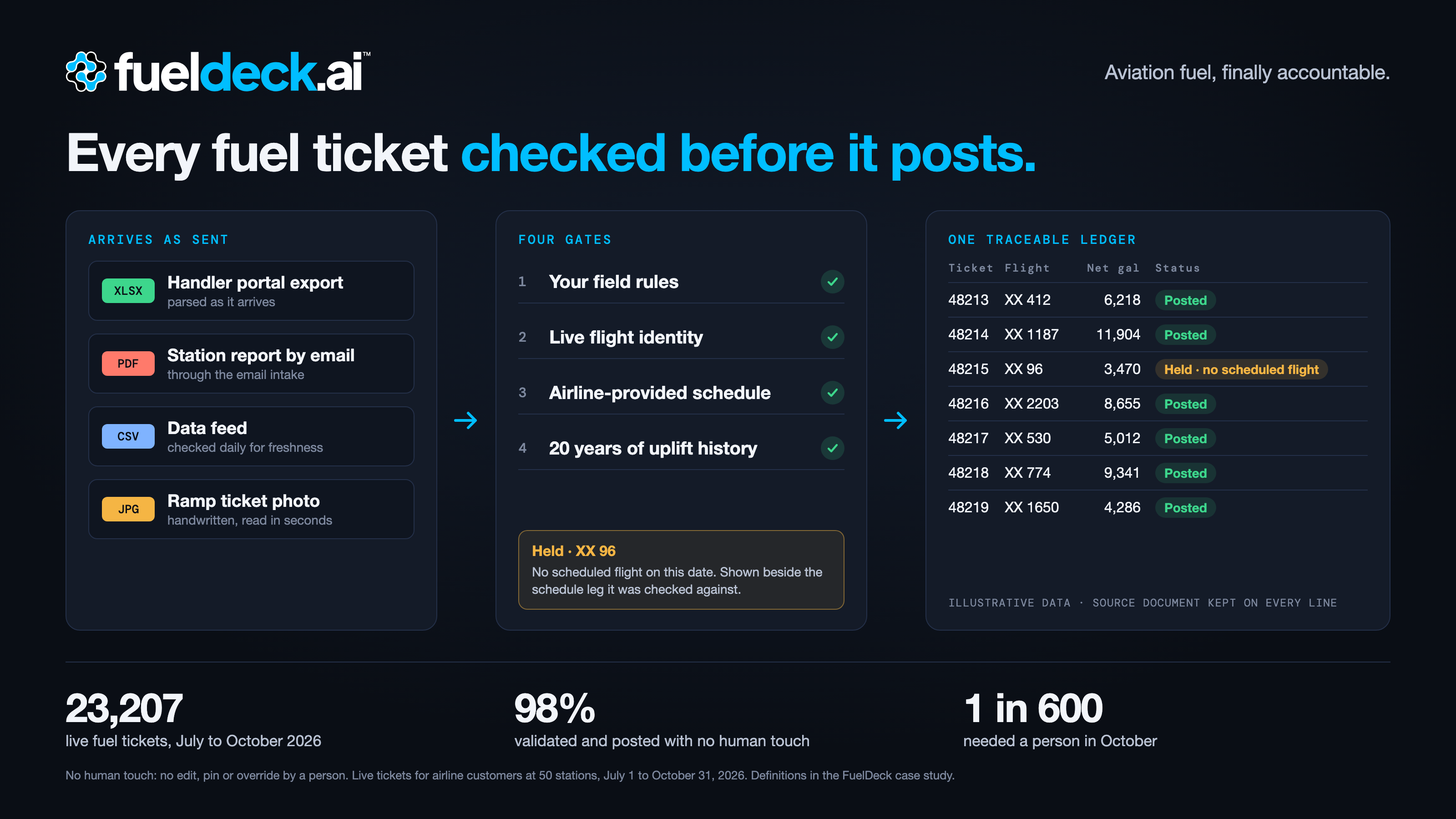
At the core of FuelDeck™ is FuelScanner™, the capture engine that reads a fuel record in whatever form it arrives. In production today that is overwhelmingly the Excel, PDF and CSV files that into-plane agents' systems export, parsed as they come; a file in a layout FuelDeck™ has not seen is held for review rather than parsed on a guess. When the record is the ticket itself, FuelScanner™'s AI, trained on real into-plane fuel tickets rather than generic documents, reads handwritten, printed, thermal and faxed tickets and ramp photographs, and returns more than 32 structured fields per ticket in under three seconds, with 99.9 percent accuracy on the four fields that decide the invoice: fuel temperature, API gravity, density and net gallons. It handles defuels, multi-hose meters and multi-ticket scans as ordinary cases, and sends any field it is unsure of to a one-click human review with the original in view, rather than making a silent guess. This is not generic OCR.
Four gates before anything posts
Reading the ticket is only the first step. FuelCounter™ runs every ticket through four validation gates before it can be posted: the customer's own field rules; a flight-identity check against live departure data; a mandatory match against the airline's published schedule; and an anomaly screen that compares the uplift with two decades of history, more than half a million historical fuel records, for that route and aircraft type. A ticket that fails a gate is held with the reason, beside the schedule leg it was checked against, not posted and found later.
Quantities are kept on their own basis. Gross, net, metered and ordered figures are preserved as written and compared only on the appropriate basis, so a difference is explained before it is called a variance. Copies, corrections and split deliveries are told apart: a re-sent report, a ticket the source changed after posting, and two trucks on one flight are three different things, and FuelDeck™ treats them as three different things, so the source, the ledger and the delivered file never drift apart.
One ledger, and the evidence behind every line
A ticket that passes posts to a single ledger that feeds inventory reconciliation, receipts and transfers, station close, and dashboards by airline, airport and route. Every posted line keeps its source document, the review decisions and the delivery status, so a challenged number or a chargeback is answered from the record rather than from an inbox search. Every validation rule and handling decision behind the ledger was written down, reviewed and signed off by fuel accountants who did the work by hand, and corrections from the field feed back into validation.
AI that works like a fuel accountant, and keeps learning
FuelDeck™'s AI does more than read. A ticket held because the flight written on it never operated is re-matched against the airline's schedule and live flight data and heals onto the flight that actually fuelled, often within minutes. Tickets are re-checked when a schedule changes, and posted tickets are re-screened, so a verdict that no longer holds is caught rather than carried into the close. Every correction a reviewer makes teaches the system, and the ledger is re-swept until the same mistake stops appearing. A case the team flags as wrong becomes a fix that a person reviews before it ships, in weeks rather than release cycles. A person stands at every gate: nothing heals past a material difference in quantity, nothing becomes a rule without sign-off, and nothing ships without review.
VersoData™ lets a fuel accountant ask the ledger a question in plain English, such as how much was uplifted at a station last month by airline, and get a table or a chart back, with the same questions answerable over an uploaded folder of mixed files. An in-app assistant that knows the platform answers questions about how FuelDeck™ works, in every module.
Data arrives on its own, and leaves the way the other side expects
FuelDeck™ runs without anyone scanning at a desk. Tickets and reports flow in automatically, as the Excel, PDF and CSV files handlers already produce, through a dedicated email intake, secure file transfer and direct connections to into-plane agent portals. Every source is checked daily for freshness, so an empty or stale download is raised rather than trusted, and a file in a format FuelDeck™ has not seen is held for review, never parsed on a guess. Validated records leave in the A4A and IATA standard XML that fuel management and accounting systems expect, with per-customer mappings, so finance teams keep their existing systems of record and an into-plane agent delivers each airline one validated record in the airline's own standard instead of six formats by hand.
The full FuelDeck™ suite
- FuelScanner™Available now
Capture of any fuel record, from the Excel, PDF and CSV files handlers export to handwritten tickets and ramp photos; 32+ fields, under three seconds, 99.9 percent on the four required fields. - FuelCounter™Available now
Four-gate validation, posting, inventory reconciliation, receipts and transfers, station close, and airline, airport and route dashboards. - VersoData™Available now
Plain-English questions over the ledger or an uploaded folder of files, with tables and charts back, plus an in-app assistant that knows the platform. - DutyCounter™Coming H2 2026
Duty and recovery reporting built from the audited flight and fuel record. - FuelTaxPRO™Coming 1H 2027
Aviation fuel tax reporting from the same ledger.
The modules do not pass files to each other. They read one audited record, written once. FuelDeck™ already supports operations at more than 480 airports and over 726 million gallons of jet fuel a year.
Nothing to install, and not a capital project
FuelDeck™ runs in the cloud, so there is nothing to install and no implementation programme to fund: onboarding confirms the sources, stations and output formats, and the first tickets flow through the intake channels a team already uses. Pricing is per ticket with volume tiers, so cost tracks the work actually done. For an into-plane agent, serving one more airline does not mean hiring one more administrator. For an airport or a smaller airline, it is an operating expense a department can approve rather than a capital project that waits for a budget cycle.
Built for enterprise finance teams
FuelDeck™ runs on Google Cloud with per-tenant isolation, role-based access control, per-company configuration, full audit logging of every privileged action, and write-only encrypted storage of customer credentials. Data is protected with TLS 1.3 in transit and AES-256 at rest. More on the trust page.
Availability
FuelDeck™ is available today at fueldeck.ai. Airlines, into-plane agents and airports can request an exploratory call or a live demonstration on their own tickets by booking a demo.
About Logicraft Corporation
Founded in 1994 by Avery J. Kraft, who leads the company today as Chief Executive Officer, and based in Englewood Cliffs, New Jersey, Logicraft Corporation provides aviation fuel accounting, reconciliation, and data services to airlines and fuel operators. For three decades the firm has reconciled fuel for airlines by hand; FuelDeck™ is that practice turned into software. FuelDeck™ is Logicraft's software platform for the aviation fuel back office. Learn more at logicraft.com and fueldeck.ai.
Media and sales contact: Ronny Kraft, Chief Technology Officer, Logicraft Corporation, through the contact form.
###
Press materials
The launch image is free to use with coverage of this announcement.